Become a Sponsor for the 2018 BDA!

1000 Friends of Iowa’s Best Development Awards – Become a sponsor!

Iowa communities are facing turning points; how they move forward impacts Iowa for generations to come.

Showcasing Iowa’s very best works raises the bar, encouraging and inspiring tomorrow’s efforts to higher levels of sustainability.

With 15 years of project winners and more to come, the Best Development Awards create a platform of sustainable growth models that are innovative, economically viable, and serve their communities well.

The Best Development Awards recognizes projects in 12 categories:

  •   Residential – New, Renovated
  •   Commercial – New, Renovated
  •   Civic – New, Renovated
  •   Mixed Use Space
  •   Innovative Leadership
  •   Storm Water Management
  •   Transportation/Complete Streets
  •   Renewable Energy
  •   Urban Placemaking/Green Space

Timeline: Award nominations open September 1, 2018. Nominees are judged by independent jurors in December and the awards ceremony is January 22,  2019.

Your generous, tax-deductible sponsorship gift will enable us to amplify awareness of innovative development works and further inspire residents, cities, businesses, and organizations to do well by Iowa’s resources. 
Won’t you become a sponsor today?

To download the full sponsorship packet, click here.

To make a sponsorship gift, click here.

Sponsorship Benefits:

To see and read more about winners, check out The Iowan Magazine feature on 2015 winners: http://bit.ly/29SV8Xh and go to https://1000friendsofiowa.org/our- programs/best-development-awards/

2016 Best Development Award Ceremony


1000 Friends of Iowa to hold 2016 Best Development Award Ceremony

January 4, 2017 (Des Moines, Iowa) – 1000 Friends of Iowa is pleased to announce the winners of its 2016 Best Development Awards. The awards program publicly recognizes efforts that visibly support the organization’s mission of responsible land use. The winners are models of responsible development practices. Julia McGuire, Award Coordinator, notes, “Our winners and their respective works will positively impact future generations of Iowans and deserve our applause.”

1000 Friends of Iowa will hold an awards ceremony on Thursday, Jan. 19, 2017 at the Iowa State Capitol Building 1st Floor Rotunda from 11:30 a.m. to 1:30 p.m. The public is invited to attend and congratulate the 2016 Best Development Award winners.

The 2016 Best Development Award winners are listed below (category, winner, project, city, short description. Long descriptions with photographs are forthcoming on the 1000 Friends of Iowa website):

    • In the Renovated Residential category, Todd Schneider for the School House Apartments in Fort Madison. The School House Apartments, a 37-unit mixed-income apartment complex, includes affordable and market-rate options and was a major reinvestment in an existing public school building. Its close proximity to downtown makes walking and cycling viable for tenants. The complex has a 300 kW solar array system and each apartment features high-efficiency appliances, hybrid electric/heat pump water heater, Iowa Green Streets-compliant plumbing, and insulation to lower the building’s energy costs and resource use.
    • In the New Commercial category, Hope Haven Area Development Center Corporation for the Hopefully Yours Thrift and Gift Shop in Burlington. After a devastating fire burned the old store to the ground, Hope Haven chose to build a brand new store to continue serving its 530 clients with disabilities and promoting the economic growth of downtown Burlington. As the first new construction on Jefferson St. in 40 years, the new store was built on space that had been vacant for nearly a decade. The architecture blends in with other downtown structures, has high efficiency HVAC, and LED lighting. It features thermally dynamic glass in all storefront glazing. The building meets ADA standards and has a Warren lift (hydraulic lift toilet). The nature of the business supports its responsible construction goals by employing 11 persons with disabilities, recycling textiles that are not suitable for sale by baling them, which in turn keeps material out of the landfill. The recycling program was also expanded to include cardboard, glass, and metals. Community support is evident by the tripling of donations and increase in sales. Donations in the new building occur under a covered drop-off area, which is more convenient for donors who are physically disabled or elderly.
    • In the Renovated Commercial category, Blackbird Investments for the Market One Building in Des Moines’ East Village. The Market One Building is on the National Register of Historic Places and adaptively reuses a factory for commercial space. A glass-enclosed conference room and 3,000 square feet of deck and shade canopy were added to the roof. The remainder of the roof was covered with photovoltaic panels and a planted (green) roof system. Additional primary sustainable building elements include: mini-rain gardens, native and perennial plantings, capture and delay water retention, geothermal heating and cooling technologies, solar photovoltaics on the parking canopy, dual flush toilets, permeable walk surfaces, lighting strategies, dedicated parking for High Occupancy Vehicle (also called HOV) workers and four charging stations for electric vehicles, and showers at each floor level. The combination of geothermal and solar energy sources along with LED lighting and an advanced refrigerant-based heating and cooling system has allowed project to achieve net-zero energy usage. The project is LEED platinum eligible.
    • In the Renovated Civic category, Angelo Architects for the Iowa Quilt Museum in Winterset. This 130-year old building is listed on the National Register of Historic Places and uses the original hardwood floors, tin ceiling, woodwork, lights, and cabinets. Energy efficient elements incorporated into the project include high efficiency HVAC, LED lighting, and removal of canvas awnings to bring natural light into the gift store. Very little environmental and economic construction impact was sustained because the building was repurposed and utilities already existed; despite minor tuckpointing, its historic status was maintained. By adaptively reusing an existing retail space, the final cost was approximately $15 per sq. ft. as opposed to estimated new construction cost of approximately $250 per sq. ft. minimum.
    • In the Mixed Use category, Indigo Dawn for the Green & Main project in Des Moines. The Green & Main project transformed an historic site from the National Register of Historic Places into a successful mixed use building with a health center on the bottom floors and a residential apartment on the upper level. Sustainability features of the site include soil quality restoration, bioswales, permeable pavers, subterranean retention, a green roof, rain gardens, rain barrels, and passive and active solar strategies. Each room can control its own climate with variable refrigerant flow technology and is supported by a geothermal well. Lighting is controlled by sensors, which feed data to the ISU Center for Building Energy Research. Waste diversion of 90 – 95% was achieved through resale, recycling, or repurposing items through site source separation.  The building sits on a bus route and has an electric charging station for alternative fuel vehicles. It is seeking LEED Platinum status.
    • In the Innovative Leadership category, Johnson County for its Solar Array and Soil Quality Restoration at Johnson County Administration Building in Iowa City. This 85 kW solar array sits above ground on a floodplain and former brownfield and armory site, and delivers 23% of the building’s electrical needs. Soil Quality Restoration beneath the array helps manage stormwater, improving water quality and reducing the amount of water that drains into nearby Ralston Creek, which outlets to the Iowa River. “Low-grow” grass under the array requires infrequent mowing. Located less than a mile from the center of Iowa City, the array and soil project are visible to thousands of passersby each day. The County has taken many outreach and education opportunities to a wide variety of organizations.
    • In the Renewable Energy category, Steffensmeier Welding and Manufacturing for its Solar Field in Pilot Grove. This project was the result of employees meeting to determine the benefits of solar energy at the manufacturing plant. The project is functioning at 100% and will significantly reduce overall costs over a 4-5 year time period with a return on costs after 5-6 years. It was designed to power all of the company’s electrical needs on a net-annual basis and is the first industrial manufacturing operation exclusively using solar energy in Iowa. With net-metering, the array will overproduce electricity in the summer, allowing credit to build with the serving utility. The credit will be drawn upon during winter months when production is lower due to shorter daylight periods and cloudy days.
    • In the Stormwater: Civic category, the City of Storm Lake for its North Central Stormwater Project in Storm Lake. This project was designed to relieve substantial overland flooding from approximately 150 acres of residential and school property. A unique treatment train concept diverts stormwater runoff from the main drainage channel into linear treatment basins instead of traditional pipe conveyance. This cost effective concept reduces infrastructure costs, provides significant regional flood control, reduces pollutant loading to Poor Farm Creek, adds aesthetics to the area, and is adaptive to future flooding. The project is the first in Iowa to use a gabion weir and sand-iron filing filtration system to remove soluble phosphorus.
    • In the Stormwater: Private category, Cherry Glen Learning Farm, for its Designed Watershed Mitigation in Polk City. Cherry Glen Learning Farm is the state’s first watershed mitigation farm. Containing two basins, the system receives mocha-looking high nitrate water and pumps clear and mostly nitrate-free water through irrigation via solar power. Forty percent of the clean water is returned to the aquifer. The farm includes acres committed to prairie and agro-forestry cropping. A high tunnel and attached greenhouse extend the growing season. Indoor and outdoor cooking centers are available for classes. On-site composting supplements the water management and improves soil health. 
    • In the Urban Placemaking category, The Alley KADTS for The Alley in Oskaloosa. An unwelcoming, litter-ridden space was transformed to an open corridor between the local mall to the historic Oskaloosa square. A grassroots group led the effort in a makeover that includes tables, umbrellas, seating, strings of LED ambience lights, planters (repurposed livestock tanks) with attached ‘walls’ for signage displays, and an artistic metal entrance archway. Many community organizations, companies, and the high school metal shop class were involved. The Alley has been used for community events, meetings, collaborations, musical and theatrical performances, as well as informal neighborly gatherings. The entrance arch embodies The Alley’s slogan, “Preserving Our Heritage While Building Our Future.”

The Best Development Award winners are selected from a pool of applicants each year and judged by an independent group of jurors. This 2016 jurors were, in alphabetical order, Liz Christiansen, Director of the Office of Sustainability at the University of Iowa; Maureen Collins-Williams, an Iowa public sector professional who trains, speaks and consults with 21st century entrepreneurs and innovators; Jeff Geerts, Special Projects Manager with the Community Development Division of the Iowa Economic Development Authority; Jeff Hanson, Community Development Operations Manager of the City of Sioux City, and Ryan Peterson, President of Impact7G.

1000 Friends of Iowa, founded in 1998, is a statewide nonprofit organization focused on land use education. Its mission is to unite Iowans in efforts to protect farmland and natural areas; revitalize neighborhoods, towns and cities; and improve quality of life for future generations. Its Best Development Awards program was established in 2001.

Additional details about each winning project and 1000 Friends of Iowa’s smart growth priorities can be found at www.1000FriendsofIowa.org.

###

1000 Friends of Iowa Announces 2016 Best Development Award Winners

BDA2016FOR IMMEDIATE RELEASE

CONTACT: Julia McGuire, Best Development Award Coordinator, 515-988-1828, awards@1000friendsofiowa.org

1000 Friends of Iowa Announces 2016 Best Development Award Winners

Dec. 27, 2016 (Des Moines, Iowa)

1000 Friends of Iowa proudly announces ten recipients as its Best Development Award winners of 2016. Five independent jurors from across the state selected projects that implement the efficient use of our resources to develop sustainable communities that provide a high quality of life.

The 2016 Best Development Award winners are listed below (category, winner, project, city):

  • In the Renovated Residential category, Todd Schneider for the School House Apartments in Fort Madison
  • In the New Commercial category, Hope Haven Area Development Center Corporation for the Hopefully Yours Thrift and Gift Shop in Burlington
  • In the Renovated Commercial category, Blackbird Investments for the Market One Building in Des Moines
  • In the Mixed Use category, Indigo Dawn for the Green & Main project in Des Moines
  • In the Innovative Leadership category, Johnson County for its Solar Array and Soil Quality Restoration at Johnson County Administration Building in Iowa City
  • In the Renewable Energy category, Steffensmeier Welding and Manufacturing for its Solar Field in Pilot Grove
  • In the Stormwater: Civic category, the City of Storm Lake for its North Central Stormwater Project in Storm Lake
  • In the Stormwater: Private category, Cherry Glen Learning Farm, for its Designed Watershed Mitigation in Polk City
  • In the Urban Placemaking category, The Alley KADTS for The Alley in Oskaloosa

“Having such inspirational nominations from all over the state brought a great close to the 2016 calendar year,” stated Kari Carney, Executive Director of 1000 Friends of Iowa. “Publicly recognizing significant projects to a wide audience is critical to our mission of educating citizens about responsible land use. I hope our Best Development Award winners will be seen as models for other community projects in 2017.”

This year’s award categories expanded to include Renewable Energy, Transportation/Complete Streets, and Placemaking/Green Space as a way for 1000 Friends of Iowa to express the fact that smart land use and sustainable communities are more than buildings. All of the nominated projects help advance sustainability across our state by considering site placement, design, water efficiency, energy management, materials and resources used, indoor environmental quality, public use, and long-term benefits.

The Best Development Award winners are selected from a pool of applicants each year and judged by an independent group of jurors. This year’s jurors were Ryan Peterson, President of Impact7G; Liz Christiansen, Director of the Office of Sustainability at the University of Iowa; Jeff Geerts, Special Projects Manager with the Community Development Division of the Iowa Economic Development Authority; Maureen Collins-Williams, an Iowa public sector professional who trains, speaks and consults with 21st century entrepreneurs and innovators; and Jeff Hanson, Community Development Operations Manager of the City of Sioux City.

Founded in 1998, 1000 Friends of Iowa is the only organization in the state focused solely on promoting responsible land use in community, state, and federal development decisions. Its mission is to unite Iowans in efforts to protect farmland and natural areas, revitalize neighborhoods, towns and cities, and improve quality of life for future generations.

Additional details about each winning project will be forthcoming.

###

Best Development Awards – Become a Sponsor!

[vc_row][vc_column][vc_column_text]


Celebrating 16 Years of Recognizing Smart Growth & Sustainable Development Across Iowa

The Best Development Awards program recognizes cities, companies, nonprofit organizations, and individuals who demonstrate how responsible development and planning practices provide benefits to the community, the environment, and quality of life for future generations. Nominated projects help advance sustainability across our state by considering site placement, design, water efficiency, energy management, materials and resources used, indoor environmental quality, public use, and long-term benefits.

Our Best Development Awards Program is made possible because of the generous donations of our sponsors. Please consider becoming a sponsor this year.  For more information on sponsorships, click here.

Click here to make a sponsorship gift.

Nominations for the 2017 Awards will open on September 1, 2017.
Download the Best Development Awards informational brochure here.
HOW TO APPLY:

STEP 1: Download the category application (see links below)

STEP 2: Review the awards program and category criteria

STEP 3: Submit your nomination by the Nov. 15th deadline

Entry Fee: $50 

Pay entry fee online by clicking here or make checks payable to: 1000 Friends of Iowa 3850 Merle Hay Road, Suite 605 Des Moines, IA 50310 (Please note Best Development Awards entry fee)

2017 Categories (Click the specific category for its application) 

Questions? Contact: Awards@1000friendsofiowa.org

Now more than ever we must raise awareness of people doing great things in our communities. We are facing a critical time when our water, land, air, and climate are so threatened by the impacts of poor land use decisions — it is imperative that we work to promote efforts that are doing it right. Because we know that smart land use and sustainable communities are more that just buildings, we’ve added three new categories this year:

  • Renewable Energy, including solar and wind for commercial and residential properties
  • Transportation/Complete Streets, including walkability and bicycle-friendly measures that cut the dependency on fossil fuels and decrease sprawl
  • Placemaking/Green Space, which turn blight and poor planning into a living vision
Want to sponsor the 2017 Best Development Awards?
Get information here, including sponsorship benefits.

1000 Friends of Iowa established the Best Development Awards in 2001 to showcase development projects and programs in Iowa that best reflect the principles of smart growth, sustainability, and uphold the mission of 1000 Friends of Iowa. We also recognize the efforts of businesses, developers, cities, organizations, and individuals responsible for these projects. The Best Development Awards are selected from a pool of applicants each year and judged by an independent group of jurors. Become a sponsor today!

Stay up to date on awards announcements and happenings on Facebook and Twitter![/vc_column_text][/vc_column][/vc_row]

Comments Needed on Transportation Plan

The Metropolitan Planning Area for Polk, Warren, and Dallas Counties is seeking comments on the proposed Transportation Improvement Program plan. This plan covers spending and transportation projects for the next four years within these counties.

The transportation decisions we make today will have long lasting impacts on our quality of life and our climate; and are a prime driver for the type of development and the type of communities we have.

1000 Friends of Iowa supports transportation projects that focus on repairing and rebuilding existing infrastructure, expanding and improving biking and pedestrian trails, and improving and expanding walkability in our urban areas.

We oppose transportation projects to build new roads designed to encourage urban sprawl – such as the proposed Grand Prairie Parkway. This road is proposed to connect Mills Civic Parkway with the Raccoon River Road and ultimately continue on to county highway G-14 in Warren County. This West Des Moines road proposal would lead to the development of hundreds of acres of farmland and woodland and takes us in the wrong direction.

To download the entire proposed plan, please click here.

Please submit comments on the proposal by July 15, 2016.

To submit comments, call or email: 

Andrew Collings at 515-334-0075 or acollings@dmampo.org

Take Action to Proct Topsoil

Protecting topsoil is one of 1000 Friends of Iowa’s highest priorities. In 2015, the Iowa Department of Natural Resources and the Environmental Protection Commission gutted the requirement to maintain at least 4 inches of topsoil on residential construction sites. Because topsoil is so crucial for flood mitigation, carbon sequestering, filtering out pollutants to keep our water clean and for growing the pants and food we depend on;  we are turning to local communities to take action to protect our topsoil.

To help communities and Iowa residents take action to adopt topsoil restoration and protection ordinances, 1000 Friends of Iowa has created a handy toolkit with how to’s, talking points and sample ordinances that we like. Get our toolkit here.

Take action! — Communities within the Greater Des Moines Metro Area have been talking about adopting a region-wide topsoil ordinance for a couple of years, but have been dragging their heels. The time to act is now!

Please do two things:

  1. Write a letter to the editor to the Des Moines Register calling on metro cities to adopt the topsoil ordinance. Submit your letters here.
  2. Contact your council members and mayor. Go to you cities home page and click on city council for contact information.

2017-2018 Topsoil ordinances

Congratulations to both the cities of Clive and Cedar Rapids for being the most recent communities to adopt topsoil restoration ordinances!

In 2017, we will reach out to additional communities around the state to adopt similar ordinances. Our soil is too precious not to.

Click here to download the toolkit

Click here to to see the Topsoil Restoration Guide from King County, WA

Click here to view the preliminary ordinance for the city of Clive

Let us know if you take this ordinance to your community by emailing us at kfoi@1000friendsofiowa.org 

Why it matters:

* Topsoil retention is very important to urban landscapes — growing plants need healthy soil. New homeowners with no topsoil left in place are often faced with very expensive soil remediation to even begin to establish healthy lawns, trees, and gardens. The savings to the building and construction industry (numbers that keep changing and are unsubstantiated) comes at a great cost to the homeowner and to the watershed.

* Rain events quickly wash fertilizers, also called nutrients, off lots that have been stripped of topsoil. This pollutes our rivers, lakes, and streams. Furthermore, it is costly for the landowner who must spend extra money for repeat fertilizer applications. Keeping soil in place contributes to natural storm water management solutions and helps build healthy, green, and more sustainable neighborhoods for future generations.

Stay updated on our topsoil protection actions at www.1000friendsofiowa.org.

Bakken Approved: Opponents Continue the Fight

Bakken hearing outside

The Iowa Utilities Board voted to approve the Bakken Pipeline  permit on Thursday, March 10 that will allow Dakota Access to build a 347-mile crude oil pipeline through the middle of our beautiful state.

Members of 1000 Friends of Iowa joined over 50 people from across Iowa who represent the Bakken Pipeline Resistance Coalition at the Iowa Utilities Board hearing today to show their opposition to the proposed Bakken Pipeline.

Despite opposition from landowners and Iowans of all walks of life, the IUB ignored our voices and better judgment, and set a dangerous precedent by granting the out-of-state corporation a permit to use eminent to take private farmland to build their pipeline.

However, the Bakken Pipeline is not a done deal. Dakota Access still has other permits that it must obtain. In addition, landowners along the proposed route are considering a lawsuit to challenge the use of eminent domain.

1000 Friends of Iowa needs your help to stop this! Here are two things you can do:

  1. Make your voice heard — Write a letter to the editor showing your opposition to the pipeline. Click here for talking points
  1. Contact your state legislators — Ask them to work to strengthen Iowa’s law to prevent eminent domain use for private gain. Click here to find your legislator

1000 Friends of Iowa has always opposed the notion of forcing private landowners to give up their property rights for corporate gain. We believe that this is, at the very least, an inappropriate, if not illegal, use of eminent domain.

Together, we can stop this pipeline. Also, please consider supporting our efforts to stop eminent domain abuse and promote responsible land use and clean energy to protect our air, water, and soil with a gift. We thank you for your support.

For inspiration on compelling letters to the editor, check out these three letters that appeared in Thursday’s paper by Matt Ohloff of Food & Water Watch; Brad Lint, executive director of Iowa Association for Justice; and Paul Lunde, candidate for the U. S. House of Representatives, District 4.

www.desmoinesregister.com/story/opinion/readers/2016/03/10/pipeline-approval-wont-serve-public-interest/81537550 

www.desmoinesregister.com/story/opinion/readers/2016/03/10/pipeline-spill-could-cost-taxpayers-long-run/81496152 

www.desmoinesregister.com/story/opinion/readers/2016/03/10/iowans-opposed-bakken-pipeline/81539600 

Best Development Awards Featured in THE IOWAN Magazine

Many of the inspiring projects recognized as winners of 1000 Friends of Iowa’s Best Development Awards are featured in THE IOWAN magazine’s July/August 2016 issue! Take a journey through the beautiful pages of THE IOWAN and discover community-driven models of sustainable planning, revitalization, and development. Download the story now, courtesy of THE IOWAN magazine, Iowan.com.

100friendsNoDate (1)


Nominations for the 2016 Best Development Awards open Sept. 1, 2016!

Click here to see the 2015 Best Development Awards program winners and details.


Call for Bakken Oil Pipeline Construction Monitors

Print

**UPDATE July 19, 2016

The Bakken Pipeline Resistance Coalition, which 1000 Friends of Iowa is a member, is looking for people to “adopt” a section of the pipeline route to watch DAPL’s construction and be the eyes and ears for justice.

To sign up to be a Pipeline monitor, just follow this link: Pipeline Monitors

Because it is crucial to protect our waters and support landowners who are trying to protect their land, we want to create a team of people along the pipeline route who can monitor their section for violations of the law.

For those who are willing to help monitor a section of the pipeline, you will:
  • Participate in a training call
  • Receive a short guidebook to the rules for either Iowa or South Dakota with all the information you need to do the monitoring
  • Monitor your segment of the pipeline when construction begins
  • Notify authorities if DAPL violates the law
  • Notify the Resistance Coalition with regular updates by posting pictures, videos, and written notes on a Facebook page
  • Work with the team to take action, especially around water crossings and on property owned by landowners who have resisted Dakota Access’ efforts to condemn their land.

We want to create a team of people across Iowa and South Dakota that can help defend our land and water.

If you’re willing to be a pipeline monitor, follow the link below and fill in your contact information. We’ll send you the call-in information for the training call and handbook.

To sign up as a monitor,  follow this link: Pipeline Monitors


**UPDATE April 12, 2016

The only thing preventing Dakota Access from beginning construction on the Bakken Pipeline is the Army Corps of Engineers permit.
With your help, we can make sure the Army Corps of Engineers denies the permit.

Take two simple actions!

  1. Sign our petition to tell the Army Corps to conduct a full environmental impact statement and to deny the permit! Just click here to sign the petition.
  2. Email Brent Cossette and Col. John Henderson at the Army Corps of Engineers and tell them a FULL and complete environmental impact statement is non-negotiable!
For talking points for your email, click here.

Currently the Army Corps of Engineers is only evaluating the project in a piecemeal fashion, rather than looking at the entire project.

This hazardous and unjust pipeline cannot be evaluated piece by piece. It is impossible for the Army Corps to grasp the true consequence and nature of this toxic project if they look at it through a narrowed lens.

Stay tuned for next steps.

Stopping the Bakken Pipeline

“Usually, terrible things that are done with the excuse that progress requires them are not really progress at all, but just terrible things.” Russell Baker

Join us Wednesday, December 16 for  the Iowa DNR’s public hearing on the proposed Bakken Pipeline.

Dakota Access, the company seeking approval to build the Bakken Pipeline, must obtain a permit from Iowa Department of Natural Resources to build its pipeline across Iowa’s public lands.

As part of its consideration of this permit, the DNR is holding a public hearing this Wednesday, Dec. 16, in Des Moines, in the auditorium of the Wallace State Office Building, 502 E. Ninth St., in Des Moines, from 5:00 to 7:00 p.m. 

That means we need a lot of you there to make sure the Iowa DNR hears us load and clear – “NO BAKKEN PIPELINE IN IOWA!”

Talking points  include:
  • The Threat to Iowa’s Soil and water. The proposed Bakken pipeline would represent an on going threat to Iowa’s precious natural resources, as countless crude oil pipeline accidents have proven. Just this January, the Bridger Pipeline poured between 40,000 and 50,000 gallons of Bakken crude into the pristine Yellowstone River.  In Iowa, the Bakken pipeline would run beneath virtually every major waterway in the state, including the Big Sioux, Des Moines, and Mississppi rivers.
  • The Threat to Iowa’s Economy. Current Iowa law would require Dakota access to provide a surety bond of just $250,000 to cover potential damages. In reality, that is just a drop in the bucket for actual clean up costs and would leave Iowa tax payers holding the bill.  Cleanup costs for just one  spill, that pumped one million gallons of crude oil into the Kalamazoo River in Michigan, have already cost over one BILLION dollars. And there is more clean up still to do. Energy Transfer Partners, the parent company of Dakota Access, wrote, “We may incur substantial environmental costs and liabilities because of the underlying risk inherent to our operations.”
  • The Assault on Landowner Rights Through Eminent Domain Abuse. Dakota Access has formally asked the three-member Iowa Utilities Board (IUB) to grant the company the power of eminent domain, which would give the company the power to force Iowa landowners to provide easements against their will. This would be an egregious abuse of eminent domain, which, by law, only can be granted when there is significant “public convenience and necessity.” However, all three members of the IUB have been appointed by Governor Branstad, whose re-election campaign received support from former Texas governor Rick Perry, now an Energy Transfer Partners’ board member.
  • The Threat to the World’s Climate. Every established scientific organization in the world has affirmed that the earth’s climate is rapidly changing and that human use of fossil fuels is the primary cause. According the former NASA climatologist, James Hansen, who was the first to address Congress on climate change nearly 30 years ago, 80% of fossil fuel reserves already discovered must remain in the ground if we are to avoid cataclysmic climate change.The Bakken pipeline would do just the opposite, facilitating the daily extraction of an additional 570,000 barrels of climate changing crude oil.


Let us know you’re coming!  Please RSVP by clicking here. 

—————————————————————————

Sample Talking Points for the IUB hearing Nov 12, 2015:

The following basic talking points are here for your reference – but do share you story and thoughts regarding the proposed Bakken Pipeline in any way you see fit!

Eminent Domain and the Pipeline

  • Dakota Access wants to use eminent domain to force land owners to allow the pipeline to be built there.
  • No private, for profit corporation should have the ability to use eminent domain to take property from the rightful owners for their own personal gain, and for the sake of profits.
  • The Bakken pipeline has no public benefit for the state of Iowa. The oil and the profits will go out of state.

The effects on agriculture land have not been thoroughly investigated:

  • Iowa farmland and recreation areas will be damaged with the pipeline’s construction and when the pipeline leaks.
  • The oil flowing through the pipeline will generate heat that will affect freeze-thaw cycles, soil microbes, wildlife, and plants.
  • According to Dr. Tom Fenton from ISU, soil compaction may reduce yields for many years.
  • The Agriculture mitigation plan does not adequately protect and restore the 3 layers of soil – topsoil, subsoil, and parent material.  Mixing the layers will reduce soil fertility.

The pipeline provides little economic benefit to Iowa and to Iowans:

  • According to ISU economist Dave Swenson, this project would create far fewer jobs are expected than Dakota Access is promoting – less than 12 permanent full-time jobs.
  • There is no guarantee that most of the jobs will be going to Iowans.
  • We’re not against jobs. Jobs should move us into the 21st century and away from oil.
  • There is no guarantee that this oil will be used in the United States since Obama lifted the ban on exporting crude oil.
  • This is not a question of pipe versus rail. All business predictions suggest the industry will continue to transport oil through both pipe AND rail in order to quickly move their products.

Pipelines leak:

  • The state’s indemnity fund for cleaning up a spill is only $250,000 – barely enough to clean up the most minor spill. Recent oil spills have cost far more in clean-up:  $70 million (2013 Mayflower, AL), $1.2 billion (2010 Kalamazoo, MI)
  • This isn’t about bad welding or poor workmanship.  It is about a corrosive, volatile substance that can destroy acres of farmland, waterways and wildlife habitat when it leaks.
  • Oil and water do not mix – creating dangers to wildlife, recreation areas, and drinking water.

This pipeline will exacerbate climate change:

  • We already have the technology we need to invest in wind & solar, moving beyond Big Oil
  • We should invest in renewable energy–creating jobs without the environmental risk to future generations

The IUB needs to require Dakota Access to perform an environmental impact study:

  • Dakota Access hasn’t done adequate environmental studies and is not required to do so.
  • The IUB has denied requests to have an environmental impact statement prepared.  Dakota Access needs to be forced to do that study before they are given a permit.
  • It is doubtful that construction crews will be able to identify and detect threatened and endangered species and not destroy them.  That is why studies need to be done.
  • It is doubtful that construction crews will be able to identify and detect archaeological artifacts and not destroy them.  That is why studies need to be done.
  • Most of the major rivers in Iowa will be crossed  including the Missouri, Mississippi, North Raccoon, South Skunk; additionally, the Jordan Aquifer would be crossed, the water source for 300,000 Iowans.
  • The IUB is counting on DNR to take into consideration the risks to the natural areas.  However DNR is only looking at sovereign lands – 3 rivers and 1 wildlife area.  The IUB needs to ensure that lands not evaluated by the DNR are examined.
  • The IUB is counting on Army Corps to evaluate impacts on the waterways of the state.  However the Corps is only looking at 17 isolated sites. The IUB should mandate impacts to waterways are evaluated.
  • The IUB can’t rely on the DNR, Corps, Archaeologists to deal with environmental impacts because they have limited jurisdiction.  The IUB needs to step up to the plate and require an environmental impact study where the other agencies do not have jurisdiction.

More About the Pipeline

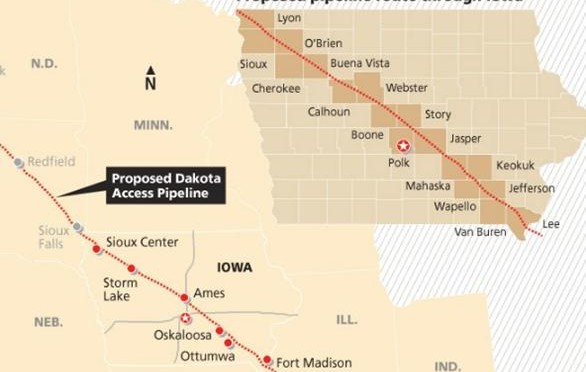
A Texas company is proposing a 343-mile underground pipeline to cut diagonally across 17 Iowa counties on its path from North Dakota to Illinois. Dallas-based Energy Transfer Partners has proposed the pipeline will span four states for a total length of 1,134 miles carrying 570,000 barrels of crude oil each day from the Bakken oil fields in North Dakota to Patoka, IL where the crude will be redistributed across the U.S.

Energy Transfer Partners has asked the Iowa Utilities Board (IUB) for permission to build the underground pipeline in Iowa. Board approval would give the company access to eminent domain powers which would force landowners to sell their property if a sale agreement is not reached. A group opposing the project asked Governor Branstad to block the proposal; a request the Governor declined.

Economic development projects should be analyzed on what we have to lose in the long run as well as short-term, one time gains. One has to ask, who stands to benefit most from this pipeline? Not Iowans.

The Bakken Pipeline Resistance Coalition’s site for a wealth of resources on the issue. The coalition has also set up Facebook and Twitter accounts to keep the public informed of the very latest.
People United for Responsible Land Use